Instructions
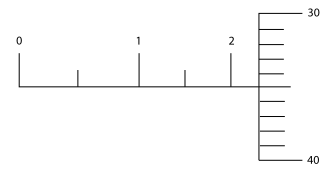
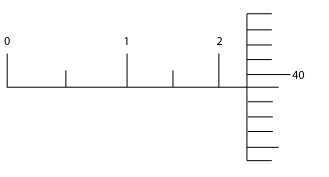
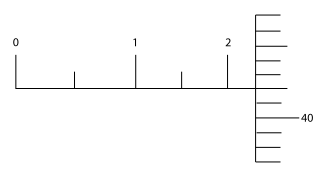
- Measure the wire diameter: Examine the three micrometer images below. Each shows a different measurement of the wire diameter. Record all three readings.
- Calculate average diameter: Find the average of your three measurements.
- Add masses: Use the apparatus below to add masses (1kg increments) and observe the wire extension.
- Measure extension: Read the vernier scale extension for each added mass.
- Record data: Write all your measurements in the data table on paper.
- Calculate Young's Modulus: Use the formula: E = (F × L) / (A × ΔL)
- Draw a graph: Plot Load (N) vs Extension (mm) on graph paper.
Formula
E = (F × L) / (A × ΔL)
- E = Young's Modulus (Pa)
- F = Force applied (N) = m × g
- L = Original length of wire (m)
- A = Cross-sectional area (m²) = πr²
- ΔL = Extension (m)
Step 1: Measure Wire Diameter (Micrometer)
Examine the three micrometer images below. Record all three diameter readings in the spaces provided.
Reading 1
Reading 2
Reading 3
Diameter Summary
-
Step 2: Apparatus Setup
Step 3: Conduct Experiment
Searle's Apparatus
Vernier Scale (Interactive)
Read the vernier scale carefully. The main scale shows mm, and the vernier scale shows 0.1 mm divisions.
Add Masses (1kg each)
Current Load: 0 × 1kg = 0g
Measure Extension (Vernier Scale)
Read the vernier scale and record the extension below.
Data Collected
| Mass Added (g) | Force (N) | Extension (mm) | Status |
|---|
Summary of Collected Data
| Mass (g) | Force (N) | Extension (mm) | Remove |
|---|
No data collected yet.
Next Steps
📊 Plot Your Graph
- On graph paper, draw a graph of Load (N) vs Extension (mm)
- Plot your data points from the table above
- Draw a best-fit line through your points
- Calculate the gradient: Gradient = ΔLoad / ΔExtension
📐 Calculate Young's Modulus
Use the formula:
E = (Gradient × L) / A
Where:
- Gradient = slope from your graph (N/mm)
- L = wire length (m) = 1.0 m
- A = cross-sectional area (m²) = π × r²
📝 Show Your Working
Wire diameter (average): - mm
Wire radius: - m
Cross-sectional area: - m²
To find Young's Modulus from your graph:
E = (Gradient × L) / A
E = (your gradient × 1.0) / your area
E = Your answer in Pa